Excavations conducted at Vieux-Vy-sur-Couesnon, in Ille-et-Vilaine, reveal the organization of a vast Gallic settlement covering 125 hectares. This discovery adds to an already considerable collection of remnants of Gallic civilization in Brittany, from Paule to Yaudet, including Huelgoat and Tronoën. It also invites a reconsideration of the claims made by archaeologist Yannick Lecerf, who stated that the Celts never came to Brittany.
Excavations conducted at Vieux-Vy-sur-Couesnon, in Ille-et-Vilaine, reveal the organization of a vast Gallic settlement spanning 125 hectares. This discovery enriches an already considerable collection of remnants of Gallic civilization in Brittany, from Paule to Yaudet, passing through Huelgoat and Tronoën. It also invites a reconsideration of the claims made by archaeologist Yannick Lecerf, who stated that the Celts never came to Brittany.
A 125-hectare oppidum at the gates of Rennes
A second excavation campaign has just concluded at the site of Bourguel, in Vieux-Vy-sur-Couesnon, northeast of Rennes. Archaeologists are studying one of the largest known Gallic oppida in Brittany, estimated to cover an area of 125 hectares.
Attributed to the Riedones, a Gallic people who occupied the Rennes basin before the Roman conquest, this fortified complex is the subject of research led by Hervé Duval-Gatignol and Yann Dufay-Garel, as part of the AGGLO collective program dedicated to settlements from the late Iron Age in northwestern Gaul.
The latest excavations have notably identified ditches bordering circulation routes, several wells, structures dug into the ground, as well as a possible artisanal installation. These discoveries confirm the existence of a structured internal organization, characteristic of a significant Gallic settlement.
Previous research had already identified the site's fortifications and collected archaeological artifacts. The presence of amphorae, reported in the press, would also testify to the commercial exchanges in which these populations participated.
Archaeologists plan to continue their investigations in 2027.
Paule, Huelgoat, Le Yaudet, Bourguel: the Gallic towns and fortresses of Brittany
Vieux-Vy-sur-Couesnon is far from being an isolated case. Several major sites testify to the importance of Gallic civilization in the Armorican peninsula.
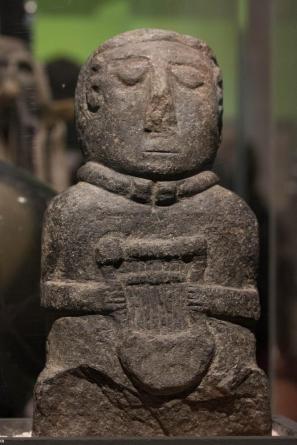
In Paule (Côtes-d'Armor), excavations at the Saint-Symphorien camp, which began in 1988 under the successive direction of several archaeologists, including Yves Menez, have revealed a vast aristocratic habitat occupied from the 6th to the 1st century BC. Fortifications, ditches, underground passages, grain reserves, metallurgical workshops, amphorae, and coins have been discovered there. The famous lyre statuette, depicting a figure holding a stringed instrument, is one of the most remarkable discoveries of Gallic Armorican archaeology. The settlement is believed to have reached around thirty hectares.
In Huelgoat (Finistère), the Artus camp https://patrimoine.bzh/gertrude-diffusion/dossier/IA29003912?utm_source=chatgpt.com is an oppidum of about 30 hectares, equipped with powerful fortifications. Excavated notably by British archaeologist Mortimer Wheeler in the 1930s, it features a wall of the type known as murus gallicus, a construction technique characteristic of several major Gallic fortifications.
At Yaudet, in Ploulec'h (Côtes-d'Armor), excavations conducted from 1991 to 2002 revealed an occupation dating back to prehistoric times, followed by significant Iron Age fortifications. The site, overlooking the estuary of the Léguer, also demonstrates the role of maritime exchanges in the Armorican economy.
At Tronoën, in Saint-Jean-Trolimon (Finistère), near the bay of Audierne, earlier excavations uncovered a Gallic sanctuary containing weapons that were deliberately bent or mutilated, fibulae, and fragments of an Italic-Celtic helmet. These ritual deposits attest to religious practices comparable to those observed in other sanctuaries in Gaul.
These sites represent only a portion of the fortified habitats, rural establishments, and places of worship from the Iron Age identified in the peninsula.
The Celts never came to Brittany?
These discoveries question the positions defended by archaeologist Yannick Lecerf, author of Bretons and Celts: the uncertainties of Celticity (2017) and Another History of Brittany as Seen by Archaeology: Beyond the Celtic Myth (2023).
In an interview with La Nouvelle République, he stated: “The Celts never came to Brittany.” According to his interpretation, Celtic migrations from Central Europe would have bypassed the Armorican peninsula, whose populations would have retained an ancient cultural identity inherited from the Neolithic.
This hypothesis, however, raises a question: how can we explain the existence, in Armorica, of large fortified settlements, sanctuaries, coins, and objects belonging to the Gallic civilization of the Iron Age?
The answer partly depends on what is meant by “Celts.” The presence of Gallic material culture does not necessarily prove a massive migration of populations from Central Europe. A civilization can also spread through exchanges, contacts, linguistic evolutions, and transformations of local societies.
On the other hand, archaeological remains undeniably establish that the peoples of Armorica participated in the Gallic civilization of the Iron Age.
A Celtic civilization born on the Atlantic facade?
British archaeologist Sir Barry Cunliffe, emeritus professor at the University of Oxford, has proposed another interpretation of Celtic origins. According to his hypothesis, Celtic languages may have developed much earlier than previously thought, as early as the Bronze Age, within the networks of exchanges connecting the populations of the European Atlantic facade.
This theory challenges the traditional model that makes Central Europe, around the Hallstatt and La Tène cultures, the exclusive center of Celtic diffusion.
Barry Cunliffe is particularly familiar with Armorica: he co-directed with Patrick Galliou the excavations at Yaudet , one of the main fortified sites on the northern Breton coast.
However, his hypothesis, presented notably in his works on the Celts of the Atlantic, does not have unanimous support among researchers. It shows that the question of Celtic origins remains open, particularly for the periods preceding the Iron Age.

On parlait une langue celtique sur la côte ouest de l'Europe il y a 4000 ans
An Armorica fully integrated into the Gallic world
On the eve of the Roman conquest, the Armorican peninsula was occupied by several peoples known to ancient authors, including the Osismii in the west, the Veneti in the south, the Coriosolites in the northeast, the Riedones around Rennes, and the Namnètes in the Nantes region.
Vous avez dit "Celtique" ? La part des Celtes dans la péninsule armoricaine (mise à jour)
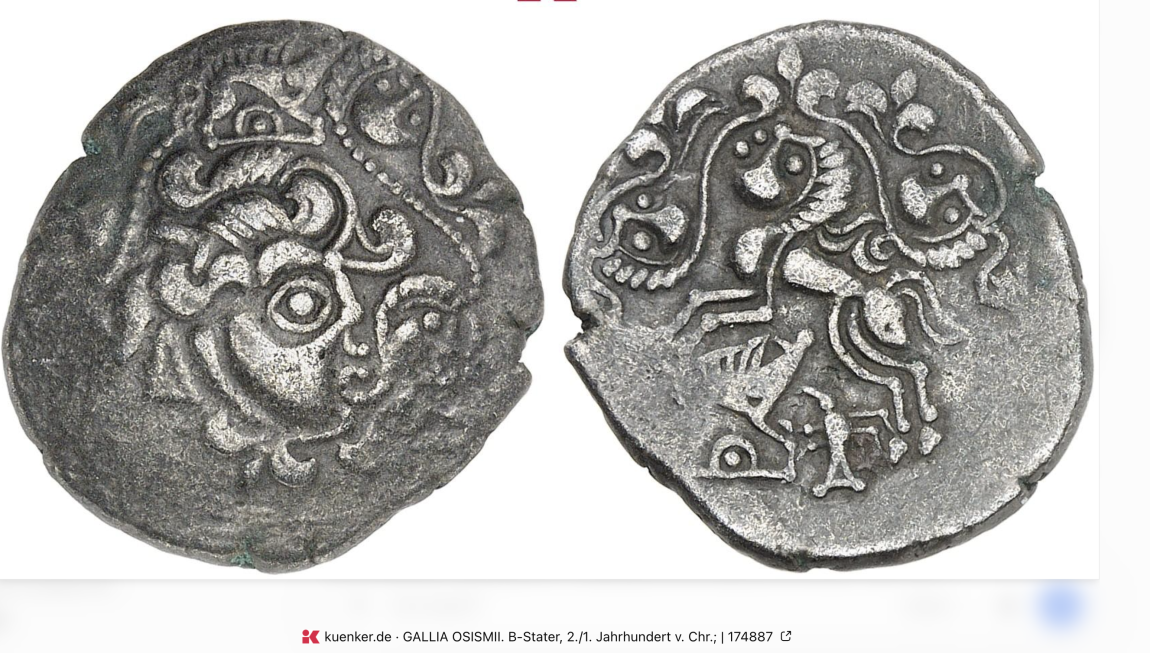
These peoples had their own territories, political organizations, trade networks, and religious traditions. They also minted coins, as evidenced by the numerous numismatic discoveries made in Brittany.
The discovery at Vieux-Vy-sur-Couesnon does not prove that the Celts arrived in Armorica at a specific date. However, it provides new elements to an archaeological reality that is already abundantly documented: long before the arrival of the Romans, Armorican Brittany belonged to the Gallic world.
It remains to be understood how this civilization developed there: through migrations, cultural diffusion, commercial contacts, or a combination of these different processes.



evezhiadennoù (0)
Evezhiadenn ebet c'hoazh. Bezit ar re gentañ o reiñ ho soñj !