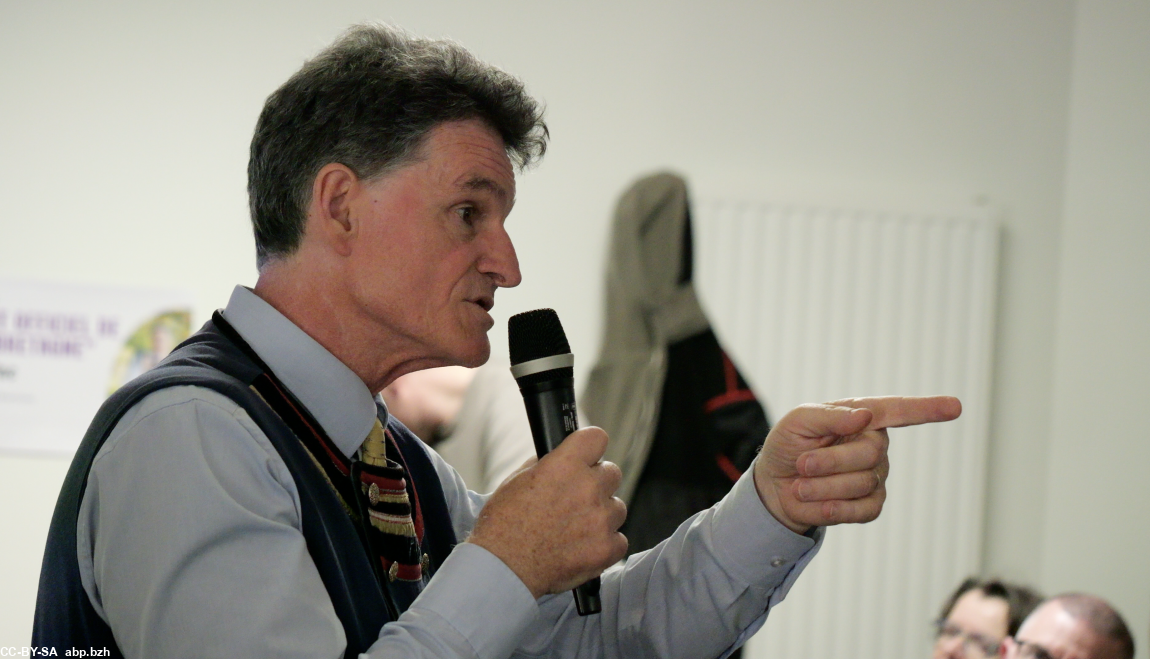
Rostrenen : lancement de « Faisons Bretagne » par Paul Molac
Réalisation : ABP – 602 vues
Intervention complète plus échanges avec la salle
In Rostrenen, in front of about a hundred participants, Breton deputy Paul Molac officially launched the movement "Let's Make Brittany" on Saturday, April 18. On this occasion, he advocated for the idea of increased regional autonomy and set a political milestone by discussing the need for recognition of Brittany in the Constitution.
The official launch of the "Faisons Bretagne" movement took place on Saturday in Rostrenen, in the Côtes d'Armor, in front of about a hundred participants. The meeting opened with a warm address from the mayor of Rostrenen, Guillaume Robic, who expressed his support for the project led by the deputy, emphasizing the need to restore decision-making powers to the territories.
From the outset, Paul Molac framed his remarks within a broad critique of the functioning of the centralized state, which he deems both ineffective and disconnected from local realities, even going so far as to describe this model as "centrality," which he presents as a true "French disease."
"We spend our time not taking care of our fellow citizens, but fighting against an administration whose decisions we know very well will not be the right ones," he stated, referring to a concrete field experience marked by late or inappropriate decisions, particularly in health and agriculture.
Through several examples — medical deserts, management of agricultural policy, training or apprenticeships — the deputy denounced an organization where decisions are made far from the territories, leading to delays, inconsistencies, and "waste of public money."
Autonomy: an organization around non-sovereign sectors
In light of this observation, Paul Molac precisely defined what he means by autonomy. Far from a project of independence, it is, according to him, a clear sharing of responsibilities between the state and the territories.
"The army, justice, foreign affairs [...] that, the state must keep. But the rest — education, mobility, health, economy — should primarily be the responsibility of local authorities," he explained, explicitly reiterating the notion of non-sovereign sectors.
In this logic, Brittany would be able to decide for itself on essential daily policies: organization of care, training of doctors, evolution of the agricultural model, transport, or even cultural and linguistic policies. For the deputy, this decision-making proximity is the key to more effective public action.
"Autonomy is not independence [...] it is a way to manage public money as closely as possible and to do better with the same resources," he insisted.
Fiscal autonomy and decision-making power
Beyond competencies, the project also relies on a profound transformation of decision-making mechanisms, particularly in financial terms. Paul Molac advocated for true fiscal autonomy allowing local elected officials to act in coherence with their program.
"Elected officials [...] with taxes that they can raise and lower themselves [...] that is simply autonomy. [...] By the way, I wonder if we don't call that democracy," he remarked.
He also criticized the normative production coming from the ministries, deemed too distant from the realities on the ground, and defended the idea of partially transferring regulatory power to local authorities, in order to allow for a more nuanced adaptation of the rules.
Inscribing Brittany in the Constitution
One of the most striking points of his intervention concerns the prospect of a constitutional reform. For Paul Molac, autonomy cannot be sustainable without strong legal recognition.
"We should [...] one day change the Constitution to inscribe Brittany in the Constitution," he asserted, believing that this would guarantee a clear and stable sharing of competencies.
Such an evolution could also, according to him, pave the way for the institutional recognition of the Breton language, notably through a form of co-officiality.
A French model against the current of Europe
To support his argument, the deputy placed the French situation in a European context marked by the generalization of regional autonomies. Spain, Italy, Germany, Belgium, and the United Kingdom were cited as examples of countries that have developed more decentralized forms of organization.
In contrast, France appears, according to him, as an isolated model. “Where is there still a centralized country that is sick? […] Turkey,” he stated, in a deliberately provocative formula intended to make an impression.
A Convincing Effort to Undertake
Beyond institutional aspects, Paul Molac emphasized the need to carry out educational work with the population. For him, one of the main obstacles remains the confusion between autonomy and independence, as well as a persistent attachment to the centralized model.
“It is necessary to explain to the Bretons that autonomy […] has nothing to do with independence […] and that, on the contrary, they will take their destiny into their own hands,” he highlighted.
The movement “Faisons Bretagne” thus aims to go beyond the circle of convinced activists to reach a broader audience, even as several opinion polls suggest a growing interest in these issues.
A Movement to Structure the Debate Across France
The deputy did, however, acknowledge that the realization of this project will necessarily require support at the national level. “We will need deputies and senators who are capable of defending this […] otherwise I fear it will remain a pious wish,” he warned.
The meeting concluded with numerous exchanges with the public, particularly regarding the strategies to adopt, possible alliances, and the political calendar. The atmosphere, attentive and engaged, confirmed that the Breton institutional question remains a living subject, awaiting structuring.
When asked about a controversy mentioned in the press regarding the mayor of Carhaix, a long-time autonomist, who had not been invited, Paul Molac responded that no personal invitation had been sent, clarifying that the meeting was open to all.


evezhiadennoù (0)
Evezhiadenn ebet c'hoazh. Bezit ar re gentañ o reiñ ho soñj !